









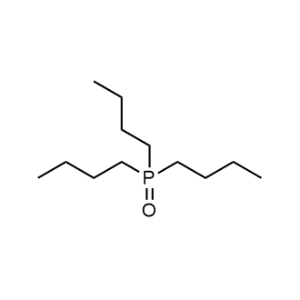
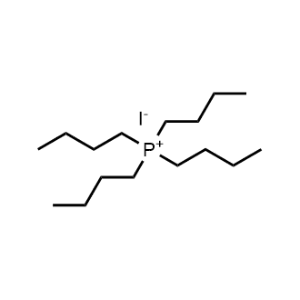
Lot numbers can be found on the outside label of a product:

Please log in for operation!
*For research and further manufacturing use only, not for direct human use.
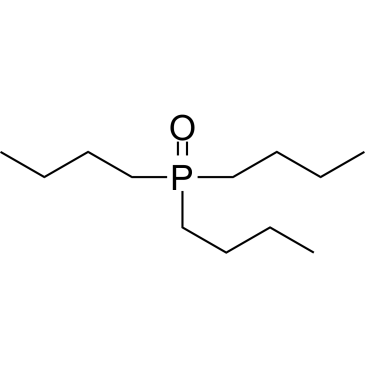
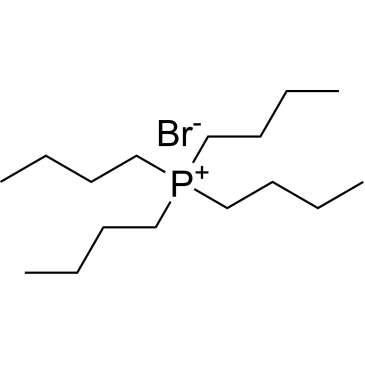
Structure of 814-29-9
| Size |
|
Price | Quantity | |||
|---|---|---|---|---|---|---|
|
* Please select Quantity before adding items. |
||||||
HCTU [1] is a novel aminium-based coupling reagent, analogous to HBTU, which in comparative studies was found to give superiort results to TBTU in the synthesis of difficult peptides [2], in hindered couplings [3], and cyclizations [4].Associated Protocols and Technical ArticlesGuide to Selection of Coupling ReagentsLiterature references[1] O. Marder, et al. (2002) Chimica Oggi, 37. [2] G. Sabatino, et al. in Peptides 2002, Proceedings of the 27th European Peptide Symposium, E. Benedetti & C. Pedone (Eds), Naples, Edizioni Ziino, 2002, pp. 272. [3] M. Gude & S. Barthlmy in Peptides 2002, Proceedings of the 27th European Peptide Symposium, E. Benedetti & C. Pedone (Eds), Naples, Edizioni Ziino, 2002, pp. 122. [4] G. Sabatino, et al. in Peptide Revolution: Genomics, Proteomics & Therapeutics, , Proc. 18th American Peptide Symposium, M. Chrev & T. K. Sawyer (Eds), Cardiff, American Peptide Society, 2003, pp. 49.
Tributylphosphine oxide serves as a stable, bench-ready byproduct in phosphine-mediated cross-coupling reactions. It functions as a reliable stoichiometric partner in Staudinger reductions and Wittig-type transformations, offering predictable reactivity and straightforward purification due to its low volatility and high solubility in common organic solvents.
|
GHS Pictogram :


|
GHS No : GHS05,GHS07
|
|
Signal Word : Danger
|
UN#: 1759
|
|
Class : 8
|
Packing Group : Ⅱ
|
|
Hazard Statements : H302+H312+H332-H314-H318
|
|
|
Precautionary Statements : P260-P261-P264-P270-P271-P280-P301+P330+P331-P302+P352-P304+P340-P330-P362+P364-P363-P405-P501
|
|
|
|
|
|
|
|
|
|
|
|
|
|
|
|
|
|
Upload Pictures
|
|
Lot numbers can be found on the outside label of a product: