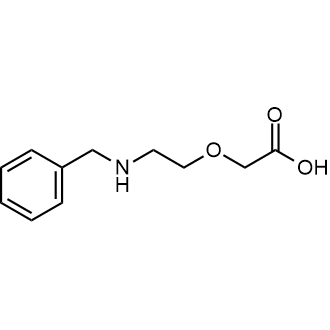
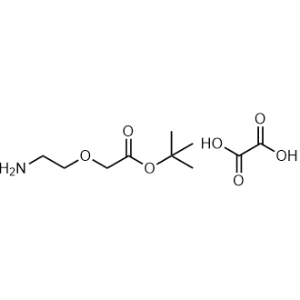
Tel:

Email:

EN
Cat. No. Size / Unit Price Qty
CS-W001157 4
Total: USD 88.00

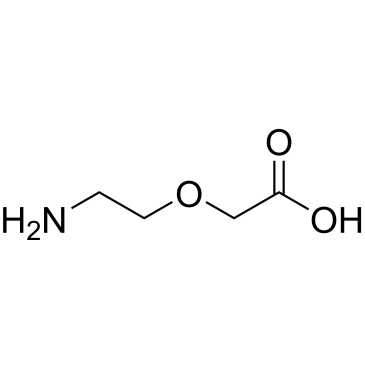
2-(2-Aminoethoxy)acetic acid

  • CAS No. 10366-71-9

  • Cat. No. CS-0127947
  • Purity≥97%
  • MDL No.MFCD09865417
  • HazMat Fee +

    HazMat Fee

    An item is classified as a dangerous good if our website displays Hazardous Material (HazMat) information for it. There is a HazMat shipping fee for each item that qualifies as a dangerous good, except in the following scenarios:

    The shipment is processed through FedEx Ground under the Limited Quantity option.

    Each bottle is packed as an Excepted Quantity, with a maximum of 1g for items in class 6.1 packing group I or II, and up to 25g for all other hazardous materials.

    If shipping is charged to your FedEx account, the HazMat fee will be billed directly by the courier. Otherwise, the fee will be included on your invoice. To help you avoid the HazMat fee, we can package a 5g order of a class 6.1 packing group I or II material as five separate 1g units, and a 100g order of any other dangerous good as four 25g units. This packaging adjustment will be made unless you instruct otherwise on your purchase order. Below, you will find the fee schedule from FedEx for handling hazardous materials.

    Type
    HazMat Fee
    Excepted Quantity $0.00
    FedEx Limited Quantities Ground $0.00
    Hazmat Ground shipping $50.00+
    Inaccessible (Haz class 6.1 or 9), Domestic $68.00+
    Accessible (Haz class 3, 4, 5 or 8), Domestic $158.00+
    Inaccessible (Haz class 6.1 or 9), International $108.00+
    Accessible (Haz class 3, 4, 5 or 8), International $238.00+

    An item is classified as a dangerous good if our website displays Hazardous Material (HazMat) information for it.

    There is a HazMat shipping fee for each item that qualifies as a dangerous good. Please contact our quotation team via email to confirm the details.

*For research and further manufacturing use only, not for direct human use.

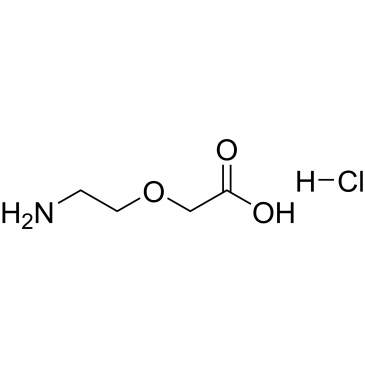
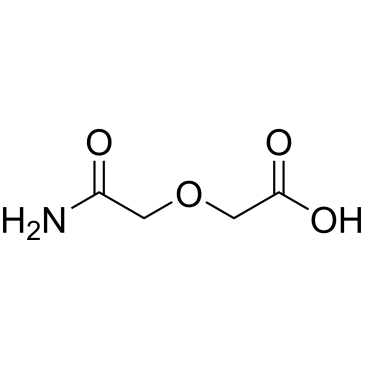
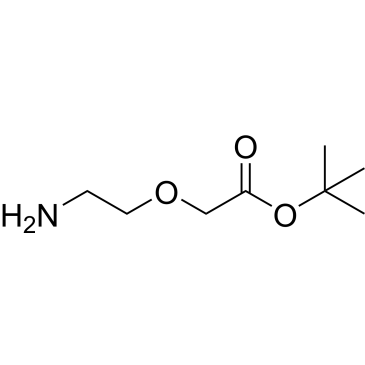
2-(2-Aminoethoxy)acetic acid|CS-0127947

Structure of 10366-71-9

Please choose your location and provide accurate information for you
Size Stock
Price Quantity

* Please select Quantity before adding items.

Description

Cyclodextrins are cyclic oligosaccharides consisting of 6, 7, or 8 glucopyranose units, usually referred to as -, -, or -cyclodextrins, respectively. These compounds have rigid doughnut-shaped structures making them natural complexing agents. The unique structures of these compounds owe their stability to intramolecular hydrogen bonding between the C2- and C3-hydroxyl groups of neighboring glucopyranose units. The molecule takes on the shape of a torus with the C2- and C3-hydroxyls located around the larger opening and the more reactive C6-hydroxyl aligned around the smaller opening. The arrangement of C6-hydroxyls opposite the hydrogen bonded C2- and C3-hydroxyls forces the oxygen bonds into close proximity within the cavity, leading to an electron rich, hydrophobic interior. The size of this hydrophobic cavity is a function of the number of glucopyranose units forming the cyclodextrin.The solubility of natural cyclodextrins is very poor. In the late 1960s, it was discovered that chemical substitutions at the 2, 3, and 6 hydroxyl sites would greatly increase solubility. Most chemically modified cyclodextrins are able to achieve a 50% (w/v) concentration in water.Cavity size is the major determinant as to which cyclodextrin is used in complexation. The cavity diameter of -cyclodextrins or -glucopyranose unit compounds is well-suited for use with molecules the size of hormones, vitamins and many compounds frequently used in tissue and cell culture applications. For this reason, -cyclodextrin is most commonly used as a complexing agent.The solubility of lipophilic drugs increases linearly with the concentration of hydroxypropyl--cyclodextrin (HBC) in aqueous solution because of the complex between HBC and the drug. This guest-host type complex is formed between the drug and the non-polar cavity in the HBC that results in enhanced solubility. Solutions may be lyophilized to produce freely soluble powders. Non-toxic in rabbits and mice.

General Information

  • CAS No. 10366-71-9
  • Cat. No. CS-0127947
  • Purity ≥97%
  • MDL No. MFCD09865417
  • Storage 4°C, protect from light
  • Shipping Room temperature in continental US; may vary elsewhere.
  • Molecular Formula C₄H₉NO₃
  • Molecular Weight 119.12
  • Synonym(s) Amino-PEG1-CH2COOH
  • SMILES O=C(O)COCCN

Computational Chemistry Data

  • TPSA   72.55
  • LogP   -0.9537
  • H_Acceptors   3
  • H_Donors   2
  • Rotatable_Bonds   4

Safety Information

Download SDS
GHS Pictogram :
GHS No : GHS05
Signal Word : Danger
UN#: 3259
Class : 8
Packing Group : Ⅲ
Hazard Statements : H314-H318
Precautionary Statements : P280-P301+P330+P331-P302+P352-P304+P340

Quality Control

To search for quality control of cas , please enter both the product number and the lot/batch number.

Other Classifications

Recently Viewed Products

Leave US a Message
Upload Pictures

Key Words

  • 2-(2-Aminoethoxy)acetic acid sigma2-(2-Aminoethoxy)acetic acid manufacturer2-(2-Aminoethoxy)acetic acid price2-(2-Aminoethoxy)acetic acid structure2-(2-Aminoethoxy)acetic acid SDSbuy 2-(2-Aminoethoxy)acetic acid2-(2-Aminoethoxy)acetic acid supplier2-(2-Aminoethoxy)acetic acid uses2-(2-Aminoethoxy)acetic acid molecular weightprice of 2-(2-Aminoethoxy)acetic acid2-(2-Aminoethoxy)acetic acid chemical name formula of 2-(2-Aminoethoxy)acetic acid
This product is not sold in the region.
Confirm
How to get a Lot Number

Lot numbers can be found on the outside label of a product:
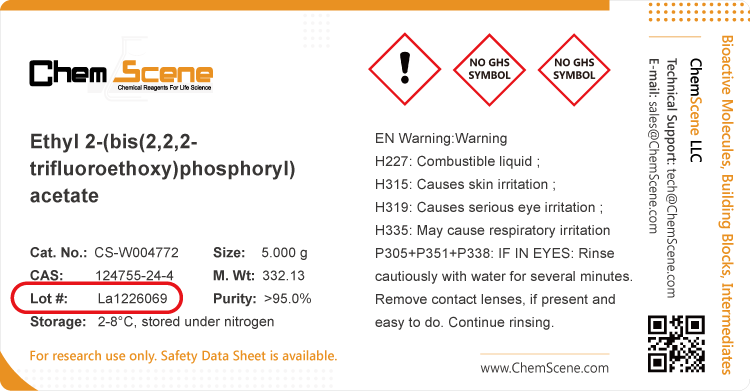
ChemScene Label